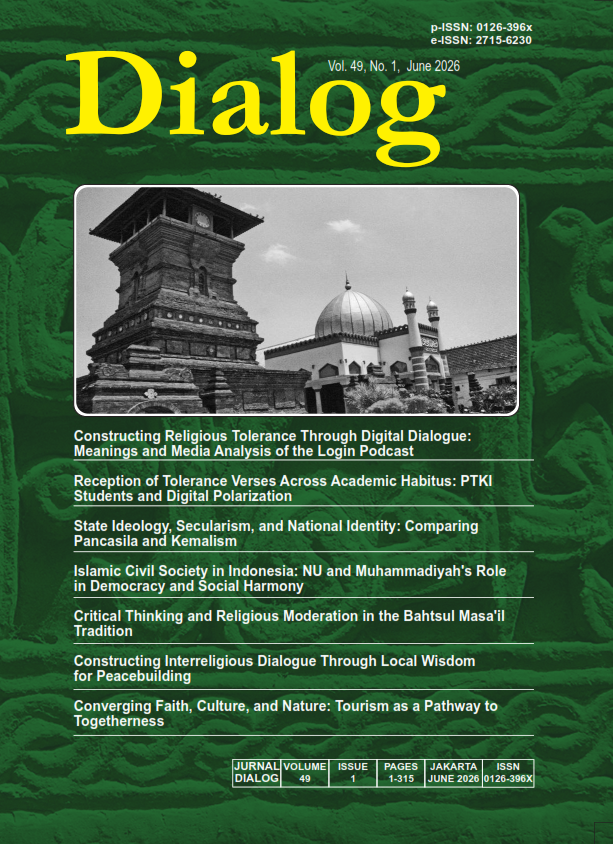
Reception of Tolerance Verses Across Academic Habitus: PTKI Students and Digital Polarization
DOI:
https://doi.org/10.47655/dialog.v49i1.1293Keywords:
academic habitus, internal polarization, living Qur'an, religious moderation, tolerance versesAbstract
Inter-sectarian debates on social media have triggered sharp internal polarization among Muslims. While previous Living Qur'an studies overlook institutional academic habitus in verse reception, this research explores how Islamic Studies master's students from five PTKIs; UIN Jakarta, PTIQ Jakarta, UIN Yogyakarta, UIN Banjarmasin, and UNIDA Gontor reproduce tolerance verses responding to digital internal conflicts. Employing a qualitative Living Qur'an approach with sociology of knowledge and habitus analysis, this study involved 22 purposively selected informants. The study reveals three primary findings. First, students' reception of tolerance verses is non-monolithic, spanning six intersecting paradigms that demonstrate the text's flexibility when engaging with readers' distinct habitus. Second, digital responses are polarized between disengagement strategies as academic distinction mechanisms and varied active strategies. Third, students' reception is constructed by an interlocking web of academic habitus, undergraduate background, organizational activism, cross-disciplinary interactions, fragmented reference authority, and digital literacy. This study demonstrates that religious moderation in the digital sphere is profoundly shaped by students' academic habitus, institutional ecosystems, and critical digital literacy.
Downloads
References
Bibliography
Abbey, R. (2018). Cass R. Sunstein. #Republic: Divided Democracy in the Age of Social Media . Princeton, NJ: Princeton University Press, 2017. American Political Thought, 7(2), 370–373. https://doi.org/10.1086/696988.
Abdullah, A. (2020). Multidisiplin, interdisiplin & transdisiplin: metode studi agama & studi Islam di era kontemporer. IB Pustaka.
Asha’Ari, M. J., Daud, S., & Mohd Suki, N. M. (2023). Linking sustainable design and social sustainability performance of chemical manufacturing firms: Moderating role of Islamic work ethics. Sustainability (Switzerland), 15(7). https://doi.org/10.3390/su15075991.
Askar, A., Nurdin, N., Pettalongi, A., Pettalongi, S. S., & Basire, J. H. I. T. (2025). Online Islamic knowledge sources and their authority in Islamic learning: a case study of Indonesian Muslim universities. Cogent Education, 12(1). https://doi.org/10.1080/2331186X.2025.2504236.
Aspinall, E. (n.d.). Jeremy Menchik. Islam and democracy in Indonesia: Tolerance without liberalism. New York: Cambridge University Press, 2016. 224 pp. Retrieved files/1076/Aspinall - Jeremy Menchik. Islam and Democracy in Indonesia Tolerance without Liberalism. New York Cambridge.pdf.
Azra, A. (2006). Islam in the Indonesian world: an account of institutional formation. Mizan Pustaka.
Bail, C. A., Argyle, L. P., Brown, T. W., Bumpus, J. P., Chen, H., Hunzaker, M. B. F., Lee, J., Mann, M., Merhout, F., & Volfovsky, A. (2018). Exposure to opposing views on social media can increase political polarization. Proceedings of the National Academy of Sciences, 115(37), 9216–9221. https://doi.org/10.1073/pnas.1804840115.
Benkler, Y., Faris, R., & Roberts, H. (2018). Network propaganda: manipulation, disinformation, and radicalization in American politics. Oxford University Press.
Bourdieu, P., & Bourdieu, P. (2008). The logic of practice (Reprinted). Stanford Univ. Press.
Brown, J. M. (2021). Twitter and Tear Gas: The Power and fragility of networked protest twitter and tear gas: The Power and fragility of networked protest , by Zeynep Tufekci, New Haven, Yale University Press, 2017, 360 pp. Also available through Digital Commons at http://www.twitterandteargas.org. Terrorism and Political Violence, 33(5), xiv–xv. https://doi.org/10.1080/09546553.2021.1939547.
Campbell, Heidi., & Cheong, P. Hope. (2024). The Oxford handbook of digital religion. Oxford University Press.
Castells, M., & Castells, M. (2000). The rise of the network society. In Information age (2nd ed). Blackwell Publishers.
Creswell, J. W., & Creswell, J. D. (2023). Research design: qualitative, quantitative, and mixed methods approaches (6th edition). Sage.
Fauzan, I., Nasution, F. A., & Regif, S. Y. (2024). Examining the models of religious harmony in anticipating hate polarization in regional head elections in Medan City. Research Journal in Advanced Humanities, 5(3). https://doi.org/10.58256/sr02ca56.
Fealy, G., White, S., & Studies, I. of S. A. (2008). Expressing Islam: religious life and politics in Indonesia. In Indonesia update series. Institute of Southeast Asian Studies.
Fuadi, M. A., Rosyadi, M. H., Marintan, M. A., Mahanani, Q. F. I., & Aslambik, M. (2024). Prevention effort of sexual violence from power inequality relations in Islamic Boarding Schools in Indonesia. Harmoni, 23(1), 1–17. https://doi.org/10.32488/harmoni.v23i1.720.
Hamid, S. (2015). Striving in the path of God: Jihad and martyrdom in Islamic Thought By Asma Afsaruddin (New York: Oxford University Press, 2013. 384 pages.). American Journal of Islam and Society, 32(3), 107–110. https://doi.org/10.35632/ajis.v32i3.992.
Hasan, N. (2002). Faith and politics: The Rise of the laskar jihad in the era of transition in Indonesia. Indonesia, 73, 145. https://doi.org/10.2307/3351472.
Hasan, N. (2008). The Salafi madrasas of Indonesia. In The Madrasa in Asia (pp. 247–274). Amsterdam University Press. https://doi.org/10.1017/9789048501380.010.
Heidi A. Campbell (ed.), & Pauline Hope Cheong (ed.). (2024). The Oxford handbook of digital religion (H. A. Campbell & P. H. Cheong, Eds.). Oxford University Press. https://doi.org/10.1093/oxfordhb/9780197549803.001.0001.
Hosen, N. (2008). Online fatwa in Indonesia: From fatwa shopping to googling a kiai," in expressing Islam: Religious life and politics in Indonesia. ISEAS.
Keskin, B. (2018). Van Dijk, Poell, and de Wall, the platform society: Public values in a connective world (2018). Markets, Globalization & Development Review, 03(03). https://doi.org/10.23860/MGDR-2018-03-03-08.
Lee, R. D. (1997). Dale F. Eickelman and James Piscatori, Muslim politics (Princeton, N.J.: Princeton University Press, 1996). Pp. 246. International Journal of Middle East Studies, 29(4), 629–631. https://doi.org/10.1017/S0020743800065260.
Lukman, F. (2018). Digital hermeneutics and a new face of The Qur`an commentary: The Qur`an in Indonesian`s facebook. Al-Jami’ah: Journal of Islamic Studies, 56(1), 95–120. https://doi.org/10.14421/ajis.2018.561.95-120.
Malkov, D., Yaqub, O., & Siepel, J. (2023). The spread of retracted research into policy literature. Quantitative Science Studies, 4(1), 68–90. https://doi.org/10.1162/qss_a_00243.
Mannheim, K. (1936). Ideology and utopia: An introduction to the sociology of knowledge. Routledge.
Mannheim, K., Wirth, L., & Shils, E. (1979). Ideology and utopia: An introduction to the sociology of knowledge. In Routledge Paperback (Reprint). Routledge & Kegan Paul.
Muis, A. A., Rahma, A., Dari, S. S. W., & Haeriah, N. (2023). Kajian mendalam tentang konsep dan implikasi sosial syirik dalam konteks keagamaan. At-Tuhfah : Jurnal Studi Keislaman, 12(2), 45–52. https://doi.org/10.32665/attuhfah.v12i2.2701.
Muthohirin, N. (2021). Da’wa in social media: The Views of Ustad Hanan Attaki and Felix Siauw to the hijrah phenomenon. Afkaruna: Indonesian Interdisciplinary Journal of Islamic Studies, 17(2), Layouting. https://doi.org/10.18196/afkaruna.v17i2.12671.
Qaraḍāwī, Y. al-. (2012). Fiqh al-wasaṭīya al-islāmīya wa’t-taǧdīd: maʿālim wa-manārāt (Ṭabʿa 3). Dār aš-Šurūq.
Rafiq, A. (2021). The Living Qur’an: Its text and practice in the function of the scripture. Jurnal Studi Ilmu-Ilmu Al-Qur’an dan Hadis, 22(2), https://doi.org/10.14421/qh.2021.2202-10.
Raya, Moch. K. F. (2025). Digital Islam: new space for authority and religious commodification among Islamic preachers in contemporary Indonesia. Contemporary Islam, 19(1), 161–194. https://doi.org/10.1007/s11562-024-00570-z.
Rusyadi, R., Degaf, A., Aziz, M. S., & Sirad, M. C. (2025). Negotiating salafism: Local Muslim identity and religious adaptation in Banten. Teosofi: Jurnal Tasawuf dan Pemikiran Islam, 15(2), 429–458. https://doi.org/10.15642/teosofi.2025.15.2.429-458.
Shihab, M. Q. (2000). Wawasan al-Quran: tafsir maudhu’i atas pelbagai persoalan umat (Cet. 10). Penerbit Mizan.
Shihab, M. Q. (2002). Tafsir al-Mishbah: pesan, kesan dan keserasian Al-Qur’an. Lentera Hati. files/1084/Shihab - 2002 - Tafsir al-Mishbah pesan, kesan dan keserasian Al-Qur’an.pdf.
Slama, M. (2017). A subtle economy of time: Social media and the transformation of Indonesia’s Islamic preacher economy. Economic Anthropology, 4(1), 94–106. https://doi.org/10.1002/sea2.12075
Solahudin, D., & Fakhruroji, M. (2020). Internet and Islamic learning practices in Indonesia: Social media, religious populism, and religious authority. Religions, 11(1). https://doi.org/10.3390/rel11010019.
Ubaidillah, & Widiastutik, R. (2025a). Virtual tafsir of Indonesian habaib: A critical discourse analysis of youtube-based Qur’ānic interpretation. Al-A’raf : Jurnal Pemikiran Islam dan Filsafat, 22(1), 95–117. https://doi.org/10.22515/ajpif.v22i1.11443.
Downloads
Published
Issue
Section
License
Copyright (c) 2026 Dialog

This work is licensed under a Creative Commons Attribution-NonCommercial-ShareAlike 4.0 International License.